Pursuit
The Setup and What It Was Going For
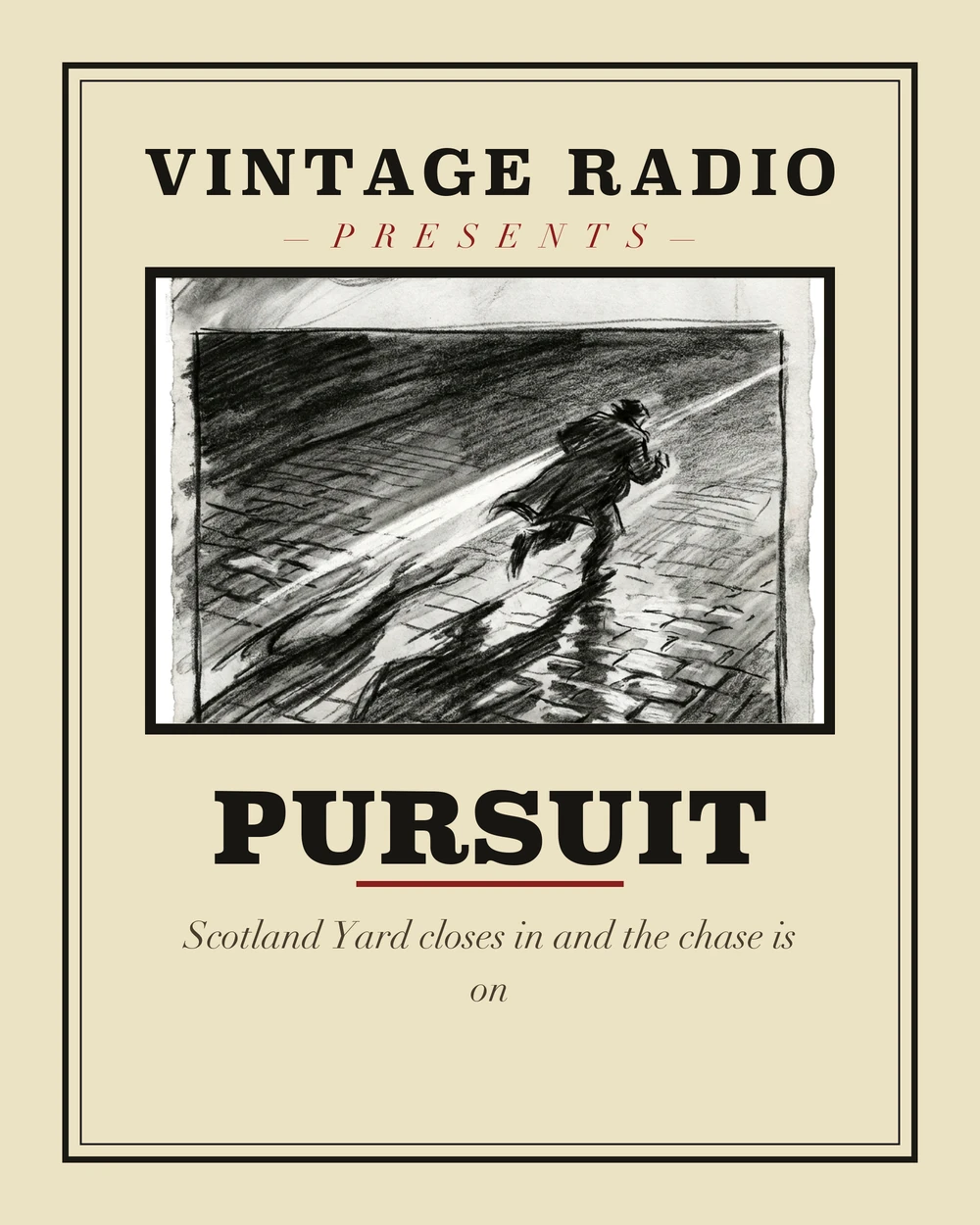
Pursuit had a clean, atmospheric premise that it announced right at the top of every episode. A criminal strikes and fades back into the shadows of his own dark world. Then a man from Scotland Yard begins a relentless, dangerous pursuit. Inspector Peter Black closes each case with the same line — "Pursuit, and the pursuit is ended" — which is either satisfying closure or reliable formula, depending on your taste. The show ran on CBS from October 27, 1949, to March 25, 1952, with a first regular season, two summer fill-in stints, and a second regular run, totaling roughly 64 episodes across four separate runs.
The show was deliberately built to tap into American radio audiences' affinity for British detective fiction, and it had the right raw material to do it: a large pool of British expatriate actors working in Hollywood who could deliver authentic accents and the right air of procedural gravity. That was the concept, and the execution varied across the show's run as casts shifted, sponsors changed, and the show kept getting slotted into vacation fills before earning a second regular season.
How It Ran — Networks, Sponsors, and Timeslots
The opening season aired on CBS Thursdays at 10:30, then moved to Fridays at 10, then to Tuesdays at 10:30 — three timeslots in a single season, which is the kind of scheduling instability that tells you a show hasn't quite found its footing with the network. Ford Motor Cars was the original sponsor, an early prestige automobile sponsorship on a CBS crime drama. That regular run ended May 9, 1950.
The summer of 1950 brought a vacation fill-in, airing Saturdays at 8 while Gene Autry was on hiatus, with Wrigley's Gum picking up the sponsorship. A second vacation slot followed from July to August 1951, filling in for Life with Luigi on Tuesdays at 9 — again with Wrigley's. Then came a second regular season, September 18, 1951 through March 25, 1952, on Tuesdays at 9:30, sponsored by Molle Shave Cream and Dr. Lyon's Tooth Powder. The sponsorship history tracks a clear arc: prestige automobile brand at launch, chewing gum during the summer filler runs, shaving cream and tooth powder in the final season. That's not a trajectory suggesting a show building in status, but the second regular season did happen, which is more than most vacation fillers can claim.
The Three Men Who Played Inspector Black
The character went through an odd naming stumble right at the start. In the audition episode and the very first broadcast on October 27, 1949, he was called Inspector Harvey. From the second episode forward, the name settled as Inspector Peter Black, and it stayed there for the rest of the run.
Ted de Corsia created the role. His full name was Edward Gildea De Corsia, born in Brooklyn in 1903 or 1905, and he had a gravelly voice and an imposing physical presence that had made him a natural villain on radio programs including The Shadow, Gang Busters, and The Adventures of Ellery Queen, where he played Sergeant Velie. Playing a Scotland Yard inspector was something of a departure from type, but de Corsia had the weight for it. He'd made his film debut in Orson Welles's The Lady from Shanghai in 1947 and was building a film noir resume that would eventually include The Naked City, The Enforcer opposite Humphrey Bogart, and The Killing under Stanley Kubrick. He played Inspector Black from the second episode through April 18, 1950.
John Dehner — birth name John Forkum, born November 23, 1915 on Staten Island — stepped in for two appearances: once on April 25, 1950, and then through the summer 1950 vacation run from July 1 through July 22. Before acting, Dehner had worked as an assistant animator at Walt Disney Studios on Fantasia and Bambi, served as a disc jockey and pianist, and worked as a World War II Army publicist. Radio Life Magazine voted him "best radio voice," and he went on to be best known in radio as Paladin on Have Gun Will Travel and as J.B. Kendall on Frontier Gentleman. There was also one episode on May 2, 1950, where Herb Butterfield played the role — a single-episode stand-in that hints at how much schedule juggling the production was doing during the transition.
Ben Wright took over the character from July 1951 through the series finale in March 1952. His full name was Benjamin Huntington Wright; he was born May 5, 1915, in London to an American father and English mother, trained at the Royal Academy of Dramatic Art beginning at age 16 — with Ida Lupino among his classmates — and served in the King's Royal Rifle Corps during World War II before coming to the United States in 1946, nominally to attend a cousin's wedding, and staying. On radio, he had played the title role on The New Adventures of Sherlock Holmes during the 1949–50 season. Radio Spirits later described him as "the last person to portray Sherlock Holmes during America's golden age of radio," and actor Parley Baer credited Wright's emergency stand-in performance in a 1947 Holmes episode with eventually landing him that full series. Parley Baer also remembered Wright as "a scholar in the best tradition of the self-educated man" and a "brilliant dialectician." In film, Wright is probably best remembered for playing the Nazi antagonist Herr Zeller in The Sound of Music in 1965, and he voiced Roger Radcliffe in One Hundred and One Dalmatians, Rama in The Jungle Book, and Grimsby in The Little Mermaid — his final role, completed shortly before his death on July 2, 1989, of complications from heart bypass surgery.
The connection between Dehner and Wright on Pursuit turned out to be a preview of a later collaboration: both went on to co-star in the radio version of Have Gun Will Travel, with Dehner as Paladin and Wright as Hey Boy.
The Production Team and How the Show Was Built
Elliott Lewis produced and directed the show. He was born Elliott Bruce Lewis in New York City on November 28, 1917, and CBS Radio Publicity gave him the nickname "Mr. Radio" for his work as actor, writer, producer, and director across somewhere north of 900 network radio productions — some sources put the number over 1,200. He started directing Pursuit in 1949 and stayed through 1952, working on it concurrently with Broadway Is My Beat and later Suspense, which he also produced and directed. He went on to create Crime Classics in 1953–54. After the golden age of radio ended, Lewis moved to television production, with credits including The Lucy Show, The Mothers-In-Law, Mayberry R.F.D., and Petticoat Junction. William N. Robson also served as producer-director on the show.
Writers Antony Ellis and E. Jack Neuman contributed scripts. The supporting cast was a reliable ensemble of Hollywood radio actors: Bill Johnstone, Jeanette Nolan, Tudor Owen, Joseph Kearns, and Raymond Lawrence, who played Inspector Black's recurring assistant Sergeant Moffet. Johnstone had a distinctive dual role — he played Chief Inspector Harkness and also served as series narrator, and beginning in the spring of 1950 the show employed an unusual dual-narration structure where Johnstone handled opening and closing narrations (and sometimes bridged commercials) while Inspector Black himself provided scene transitions and case narration from within the story. Don Baker and Bob Stevenson handled announcing duties. Sound effects were the work of Clark Casey, Ross Murray, and Berne Surrey.
The music changed across the show's runs in ways that tracked the overall production shift. Leith Stevens conducted an orchestra for the 1949–50 season. Marlin Skiles provided music during the summer 1950 vacation run. By the 1951–52 season, Eddie Dunstedter had taken over on organ — a leaner, cheaper sound that reflected where the show stood by its final run.
What Survives
Out of roughly 64 episodes, about a dozen are known to survive. The de Corsia episodes that made it through include "Three For All" from November 10, 1949, "Pursuit of the Tall Man" from January 6, 1950, "Pursuit on Lundy Island" from February 7, 1950, and "Pursuit and the Man Who Confessed" from April 11, 1950. The Dehner summer run is represented by four consecutive July 1950 episodes: "Pursuit of the Man Who Couldn't Go Home," "Pursuit of the Masked Five," "Pursuit of the Limehouse Killers," and "Pursuit in the North Sea." The Ben Wright era has the most survivors, including "Pursuit of the Lonely Heart," "Pursuit and the Knife Boys," "Pursuit at the Vicarage," "Pursuit and the Ladies of Farthing Street," "Pursuit and the Man Who Died Late," "Pursuit of the Night Ferry," and "The Asiatic Killer" from March 11, 1952, near the end of the run. A comprehensive episode log was compiled by OTR researcher Stewart Wright.
The show has been described by researchers as underrated, and the surviving episodes bear that out enough to make the losses worth noting. Three casts, four runs, two regular seasons, a pair of vacation fill-in stints — Pursuit was a show that kept coming back despite never quite landing a stable footing, and the episodes that remain give a reasonable sense of what the different eras sounded like and how the production evolved across its three years on CBS.